How Casino Words Became Part of Everyday Metaphor
Explore casino word history through ante, bluff, and jackpot, and learn how to separate documented meanings from plausible but unverified origin stories.
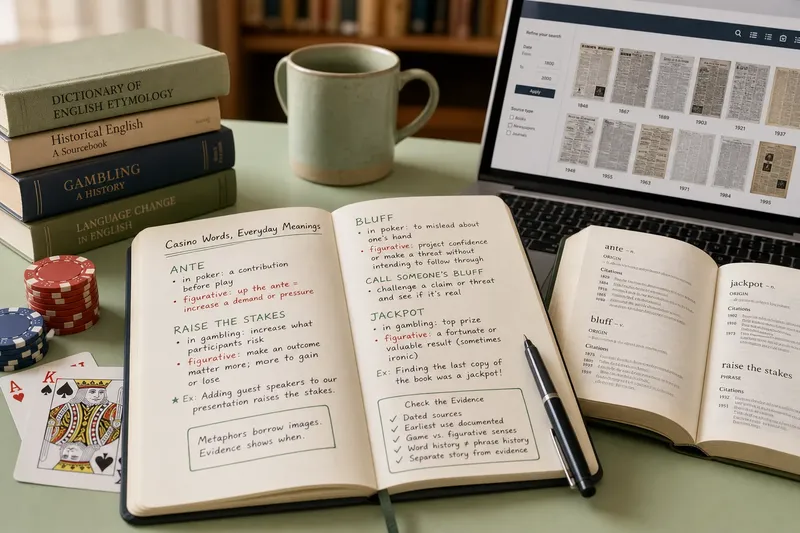
A student can “raise the stakes” in a classroom presentation without placing a wager. Casino word history helps explain why terms such as stakes, ante, bluff, and jackpot now describe risk, pressure, misleading appearances, and good fortune beyond games.
How does casino word history explain everyday metaphors?
Gambling gives abstract choices visible forms: participants put something at risk, contribute before play, or try to mislead an opponent. Everyday speech borrows those actions to describe decisions and social situations that involve no actual betting.
That logic explains a metaphor’s image, but it does not establish when a word or phrase arose. For that, a reader needs dated evidence from sources such as historical dictionaries, books, newspapers, or digitized archives.
Etymology traces a word’s form and history; semantic change describes shifts or additions in meaning. A word can retain a game-related sense while acquiring a figurative one, leaving both meanings available to speakers.
What can the evidence tell us about “ante” and “raise the stakes”?
In poker, an ante is a contribution made before a hand begins. The term is connected with the idea of putting something forward in advance, but that basic association does not by itself establish the history of the expression up the ante.
In current figurative use, up the ante means increasing a demand, commitment, or pressure. Raise the stakes draws on the idea of what participants risk in a contest and now commonly means making an outcome matter more because more may be gained or lost.
Imagine a language class planning a short campus-festival presentation comparing Korean and Vietnamese greetings. The group then adds a live demonstration with two guest speakers; classmates might say the change “raises the stakes” because it calls for more coordination and brings greater public attention. This invented situation illustrates the present-day metaphor, not the phrase’s historical origin.
Why does “bluff” describe more than poker?
In poker, to bluff is to mislead opponents about one’s hand. In broader speech, the verb can describe projecting confidence or knowledge a person may not have, or making a threat they may not carry out.
To call someone’s bluff is to challenge a claim or threat and see whether the person will support it. The expression retains the game’s image of one person presenting an appearance and another refusing to accept it without question.
How did “jackpot” acquire a figurative use?
Jackpot has roots in gambling terminology and is also used for a valuable or fortunate result. The figurative sense emphasizes a rewarding outcome without requiring the mechanics of any particular game.
Say a student needs a particular course reading, and a librarian points out an available copy on a nearby shelf. The student might call the discovery a “jackpot”: the word highlights the useful result, not a literal prize. In an ironic tone, it can also describe a result that brings trouble rather than pleasure.
How can learners check casino word history?
Historical dictionaries and dated text collections help distinguish documented use from a plausible-sounding account. For English, a learner might consult the Oxford English Dictionary or search a university library’s digitized books and newspapers, comparing dated examples rather than treating a single modern sentence as proof of origin.
- Check whether the source provides dated citations: If it gives examples from different periods, compare their dates and wording; if it offers only a current definition, use it for present meaning rather than a historical timeline.
- Look for the earliest use the source documents: If it provides an attested example, call it an early recorded use; if it does not establish one, do not call a candidate the first use.
- Compare game and figurative senses: If dated examples document both, explain that both are attested; if they document only one, do not claim the other had already developed.
- Separate a word’s history from a phrase’s history: If a dictionary traces the word but not the full expression, report only the word’s history; if it documents the phrase too, describe only what that evidence supports.
- Check whether a memorable story has dated support: If multiple dated sources support the account, describe the pattern cautiously; if it rests on an unsupported anecdote, identify it as unconfirmed or omit it.
- Keep current meaning distinct from historical evidence: If a sentence uses “raise the stakes” figuratively, explain that present sense; if the question is when the expression developed, consult dated records instead of inferring a date from the metaphor.
Imagine a student searches a university library database for early uses of “up the ante.” The student begins with a dictionary entry, copies its dated quotations, and compares them with a modern newspaper sentence about negotiation. If the older citations concern a game and the newer sentence is figurative, the student can report that the consulted sources document both uses; the search does not establish the expression’s absolute first use.
What do learners ask about casino word histories?
Does “raise the stakes” always refer to gambling?
No. It commonly describes greater consequences or commitment in a non-gambling situation, though a sentence about a wager may use the literal game sense. The metaphor’s history explains its image, not the meaning of every individual sentence.
Does “call someone’s bluff” mean the same thing as “bluff”?
They are related, but not interchangeable in every sentence. To call someone’s bluff is to challenge a claim or threat and see whether the person will back it up.
Can “jackpot” refer to something other than money?
Yes. It can describe a useful discovery or fortunate outcome because the figurative sense emphasizes a valuable result rather than the form of a prize. Tone may also make the word ironic.
Can a dictionary prove the first use of a phrase?
A dated citation can show that a phrase was in use by that date, but the earliest citation a dictionary records is not necessarily the first time anyone said it. Treat a documented example as evidence of use, not as a complete record of a phrase’s beginnings.
What can casino word history explain?
Casino word history can show how the language of wagering supplies compact images for risk, commitment, challenge, and reward. It can also help learners distinguish documented developments from origin stories that sound convincing but lack evidence.
Keep the research question precise: are you tracing a word’s roots, the development of a phrase, or the meaning it has in a particular sentence? Evidence for one question can inform the others, but it does not automatically answer them.